
Socializing with strangers should be more common and rewarding
How “social” apps fail
(1) Social media is anything but social. This part I probably don’t even need to explain: but there’s nothing healthy about primarily ‘socializing’ on a device. And the way these platforms are set up is to maximize consuming your attention: not facilitate healthy social interactions. But relatedly, and maybe worst of all, it just takes us out of real life. It takes us away from our local communities and further fractures an already fractured culture.
The rest of the tech on this list are at least focused on IRL connection, but here’s why they still fail:
(2) Most people have realized by now that dating apps aren’t a healthy way to meet people, even if you happen to be single. Dating apps assume it’s healthy to want to start a relationship right away, based on nothing more than a photo and bio. But healthy relationships usually develop slowly over time and involve a deep chemistry that can’t be predicted by glancing at a profile page.
(3) Friendship apps function like dating apps and suffer from similar pitfalls. They try to pull a committed friendship out of a profile pic, bio, and what amounts to a friend date. But, again, most relationships form slowly over time. And furthermore, they typically form around shared interests in group settings.
(4) Next, most of us don’t want to sign up to a meetup community and wait on hosts to decide when and where we’re going to do what. We have dynamic interests. We’re reading books, watching movies, listening to podcasts, stalking artists and all kinds of stuff. No single community will capture that, and we’re all tired of being in a zillion group chats waiting for hosts to set something up, or having to set it up ourselves.
(5) You can say something similar about apps dedicated to specific hobbies, like sports. I don’t play pickleball enough to install that pickleball app. And generally, if I’m up for pickleball it’s not likely going to be when the host happens to be organizing it. These apps almost always die because they’re too focused on a single niche, and can’t reach the critical mass they need to keep the platform going.
(6) Finally, the newest thing out there are apps curating dinner or lunch among groups of strangers. They’re billed as a way to find friends, or just enjoy a platonic night out – and they make use of algorithms to try to ensure chemistry between participants. This is the kind of low-commitment social interaction that mimics how most healthy relationships develop. Most friends start out as acquaintances in environments where there’s little to no pressure to form a serious relationship, i.e. school, work, clubs, and so on. But the problem with these apps is that there’s no replay value (as we say in the gaming industry). People don’t want to have dinners with strangers regularly unless there’s some deeper hook; the only way we’re coming back is if the matching algorithms can consistently deliver interesting dinners. In the case of all of these apps to date, their algorithms track things like socioeconomic status and pseudo-scientific personality tests. Like the social apps that came before, that’s still too superficial. And people can tell, so they struggle to retain members.
So in summary, many (most?) of us out there looking to socialize more aren’t looking to start a serious relationship. We don’t want to “find our tribe”, or join a pickleball community. We don’t even necessarily want to “find new friends”. And we don’t want to hang out with strangers with nothing in common. We just want to socialize IRL about stuff we’re interested in conveniently and without a big social commitment.

It’s dire, folks
In a recent survey from Harvard, 23% of respondents said they had “serious feelings of loneliness.” Among the lonely, 65% said they feel “fundamentally separate or disconnected from others or the world.” In the UK, one in ten adults report having “no close friends.”
People are suffering from the lack of healthy relationships. As discussed earlier, improving social health isn’t something an app can fix with a swipe. Trust, friendship, and a sense of belonging all develop slowly over time. And in the modern rat race, even close friends struggle to organize their get-togethers.
So all this leaves us in need of a solution that somehow keeps things convenient, casual, and offline, while offering more than just a generic meeting with strangers. The ideal solution should at least be able to curate engaging conversations with people in your neighborhood on a regular basis.

Making it more common and rewarding to socialize with strangers
A central insight from philosophy since at least Socrates is that shared interests fuel social engagement. Without uncovering the interests each party shares, conversations fizzle out. In any city, there are tens of thousands of people near us watching the same shows, reading the same books, or following the same influencers. Among those thousands of people, likely dozens or hundreds of them are strongly interested in those subjects and are available precisely when we are. Therefore, conveniently curating a more vibrant social life IRL is a perfectly clear logistical challenge. But how do we solve it?
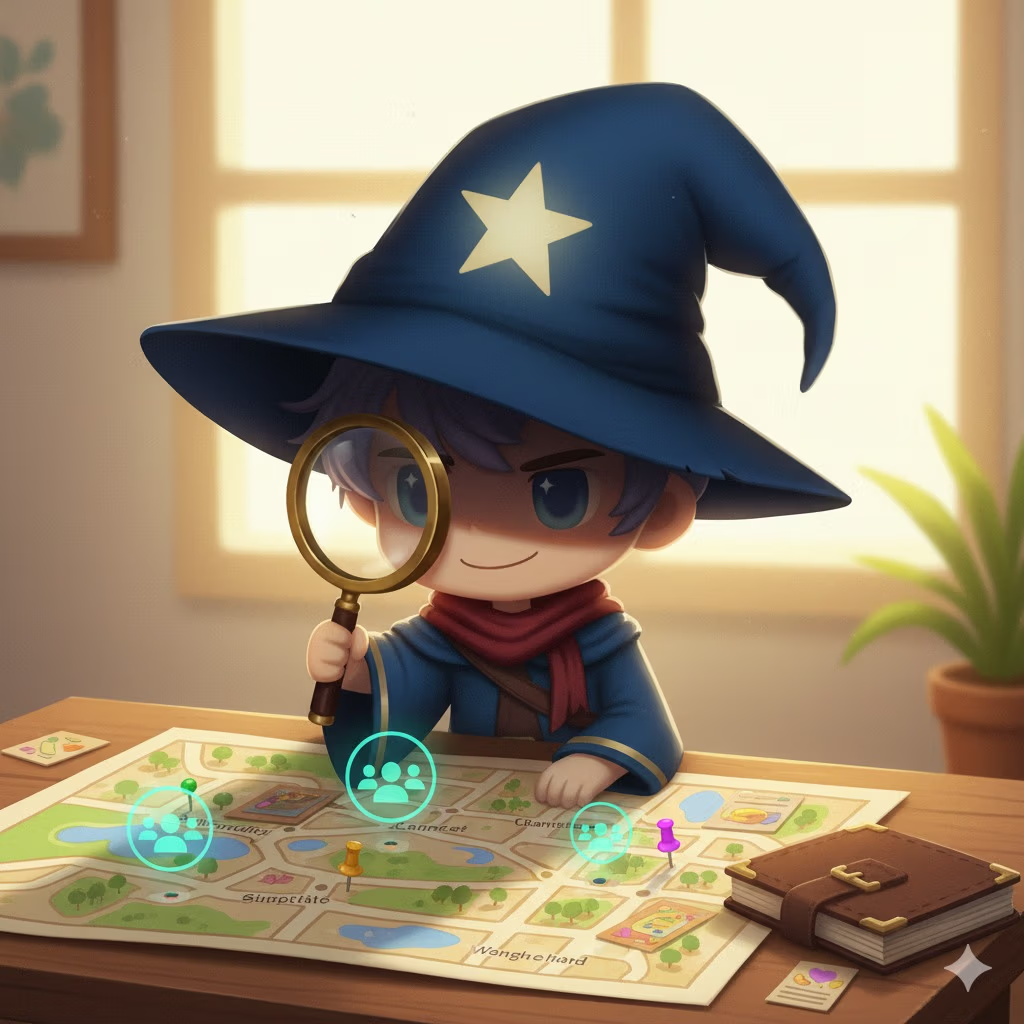
That’s where AI can provide some timely assistance. In this case, Chancey. Chancey is a meetup organizer with an AI brain. Subscribers share what they want to socialize about with Chancey, he takes everyone’s interests into consideration at the same time, and then he curates a personalized list of options to each member. The topics people match on become small, local meetups! The result is a social platform that checks all the boxes we asked for: convenient, casual, offline, and optimized for strong shared interests as the basis for meeting.

Joining Chancey

Chancey is now available in Kuala Lumpur. He’ll curate matches to you for just 5 bucks a month. (And if nothing suits your fancy, or there’s just no one looking near you – he’ll keep searching and organizing for you for free.)
Our subscribers are our heroes, and we will go to the ends of the earth to make engaging meetups happen for them. Keeping Chancey alive costs a fraction of what it takes to run a coffee shop – and thankfully less than a latte per month from each subscriber.
Anyway, that’s it for now. If you made it this far, thank you! I hope you enjoyed the analysis. I really want to hear your thoughts about the flaws in social apps, and what else we can do to make socializing IRL more common and exciting! Please reach out.
Warm wishes & solidarity,
-Chance